Comparing hand and controller raycasting in an MR enviornment
Tags:
Quantitative Research | VR
Problem
With advancements in hand tracking hardware since 2019, mixed reality input options have expanded. However, the impact of input methods on user performance remains unclear.
Motivation
Does the input method—controller raycasting vs. hand raycasting—significantly affect speed and accuracy in a Mixed Reality environment.
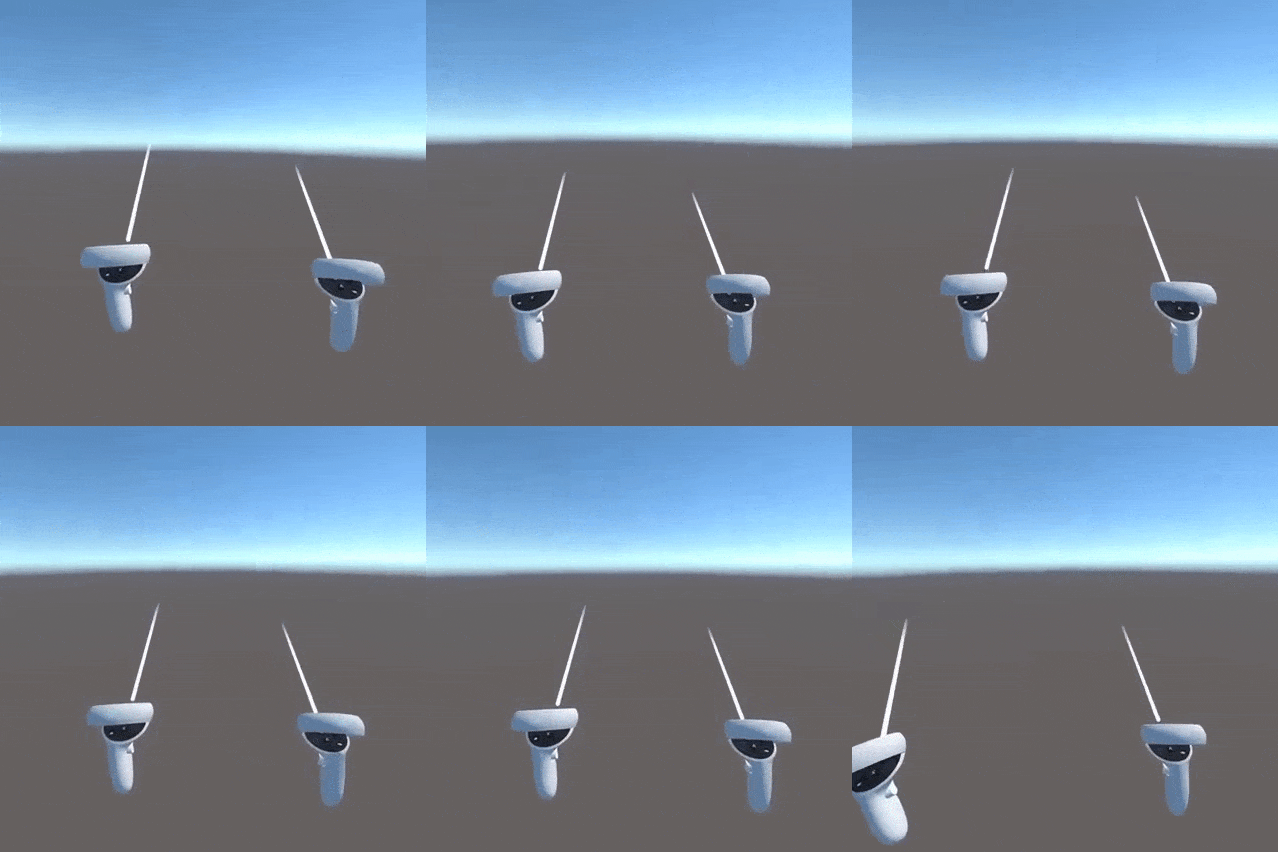
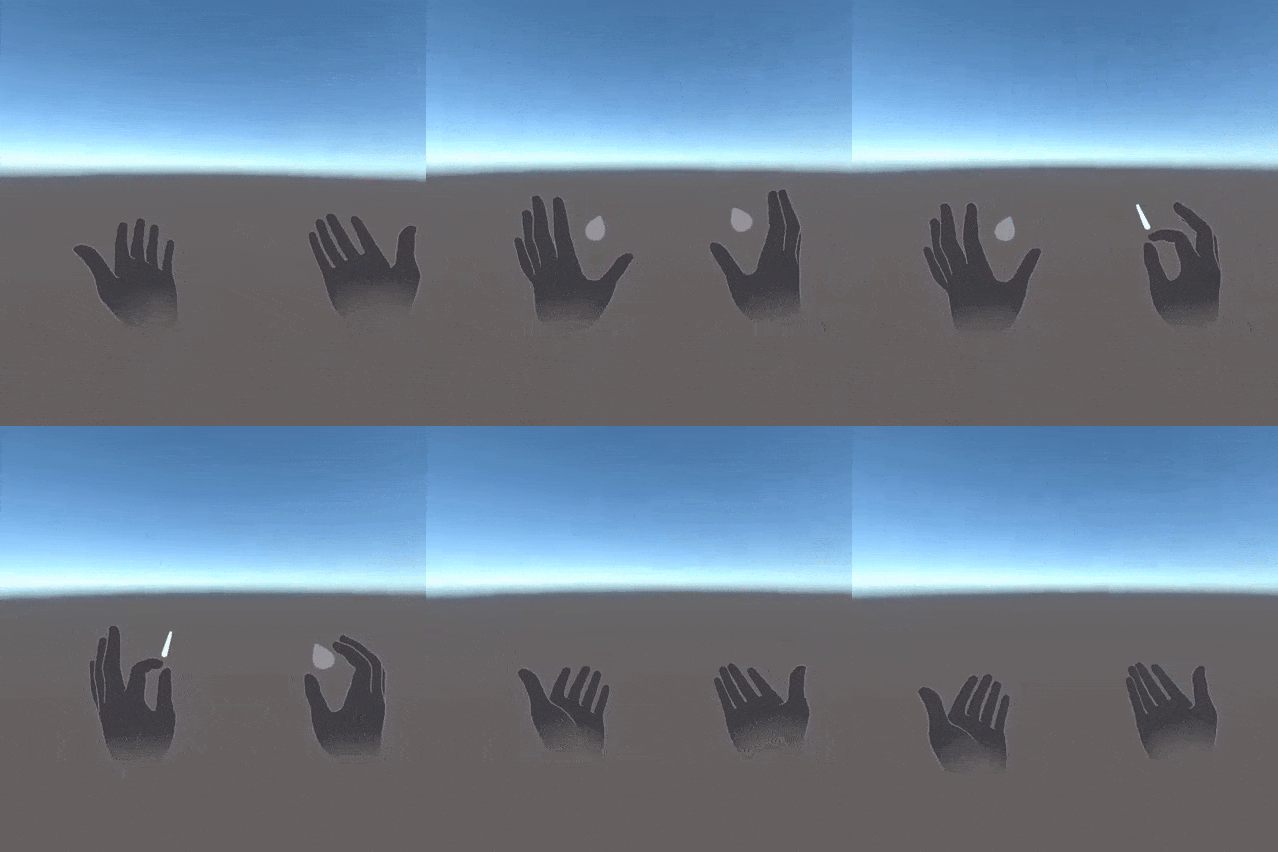
Result
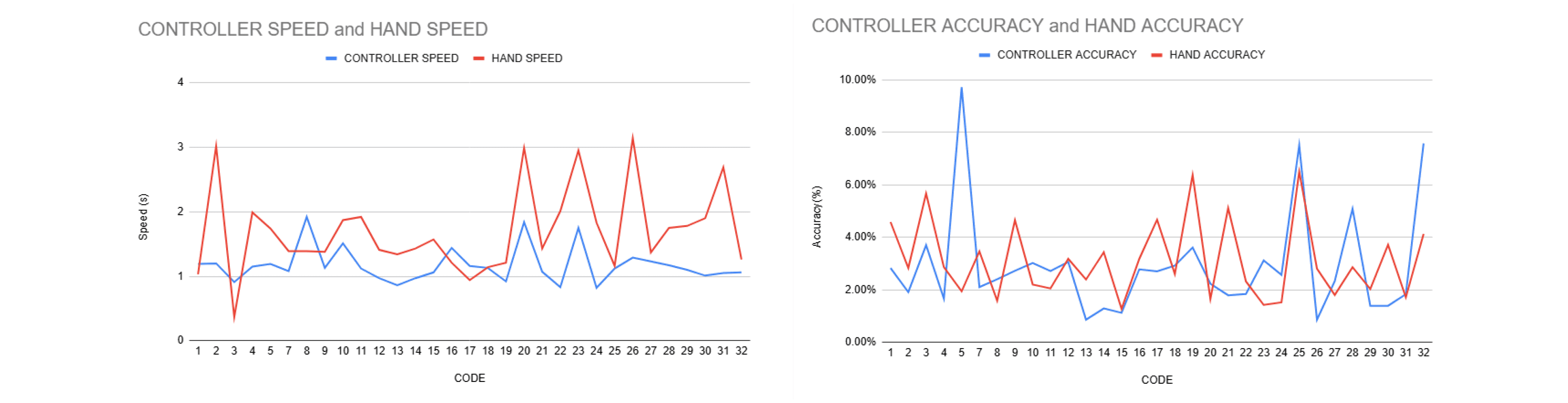
Controller raycasting speed is faster compared the the hand raycasting speed.
There is no difference in the accuracy between the two input methods.
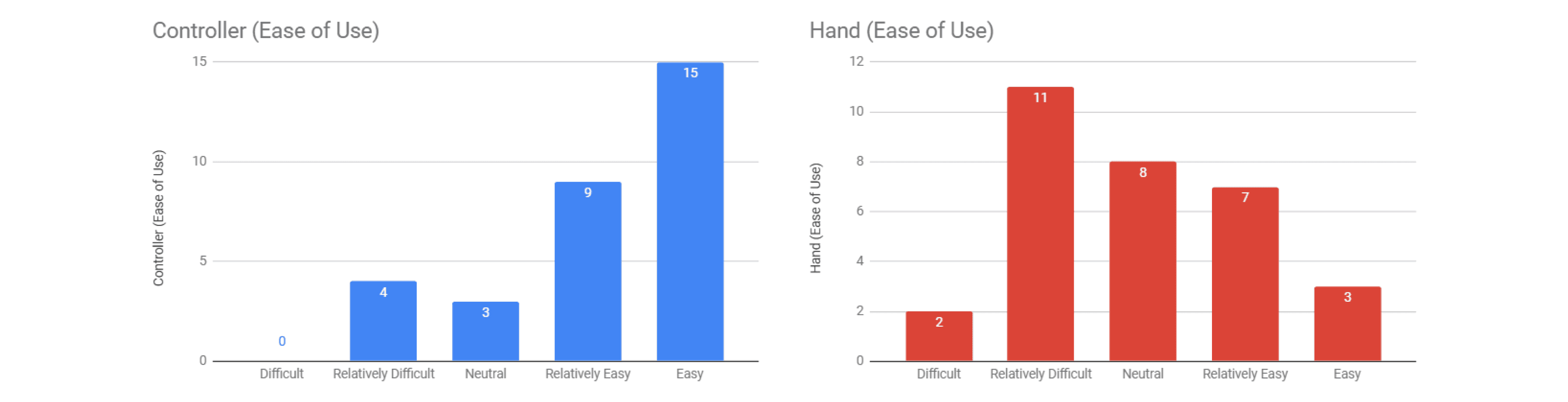
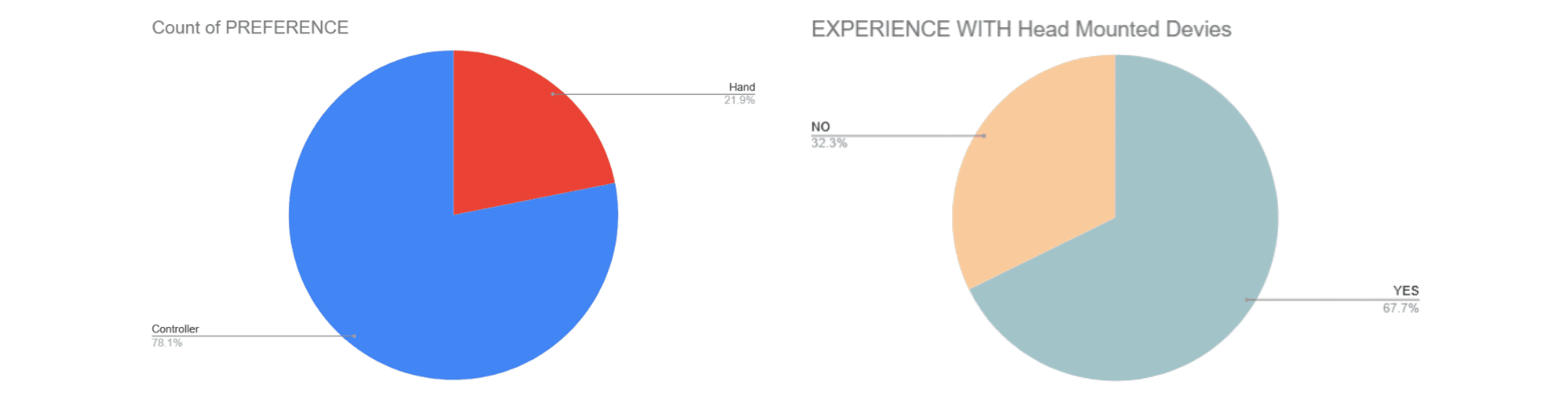
Controller raycasting was found to be easier to use than hand raycasting and found to be a more preferred method.
Positioning:
Metric | Controller Raycasting | Hand Raycasting |
|---|---|---|
Accuracy | Higher (More precise, Less jitter) | Lower (Prone to jitter and the "Heisenberg effect" from pinch/selection gestures). |
Speed | Faster (More efficient for target selection) | Slower (Can involve more arm movement/fatigue) |
Literature Review
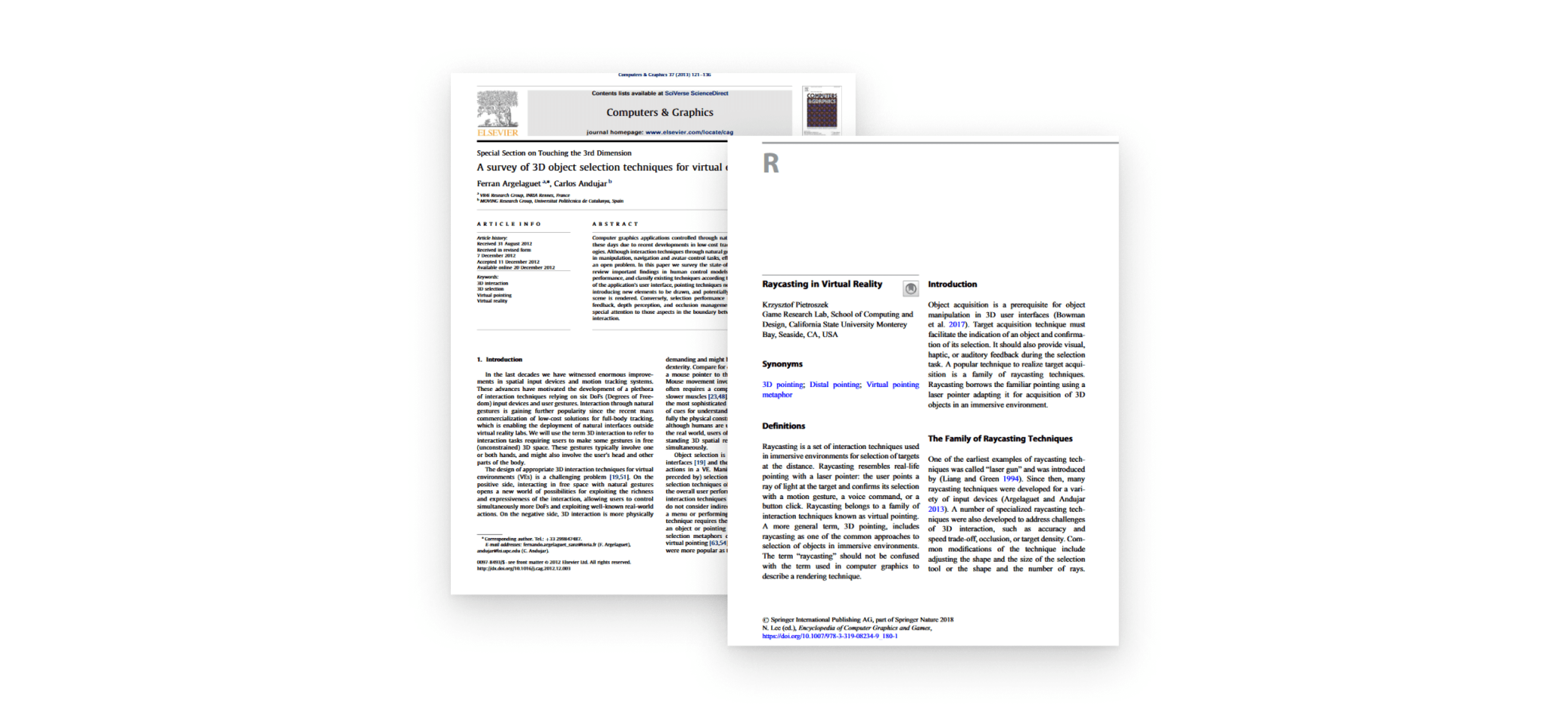
We referred to A Survey of 3D Object Selection Techniques for Virtual Environments by Ferran Argelaguet and Carlos Andújar (2013), and Raycasting in Virtual Reality by Krzysztof Pietroszek (2018) to understand existing methods and principles of object selection and interaction in VR environments.
Hypothesis
NULL HYPOTHESIS | ALTERNATE HYPOTHESIS |
|---|---|
There is no significant difference in speed and accuracy tasks between controller and hand raycasting input methods in an MR environment. | Using controller will result in a significantly higher speed and/or significantly higher accuracy compared to using hand for input tasks in an MR environment. |
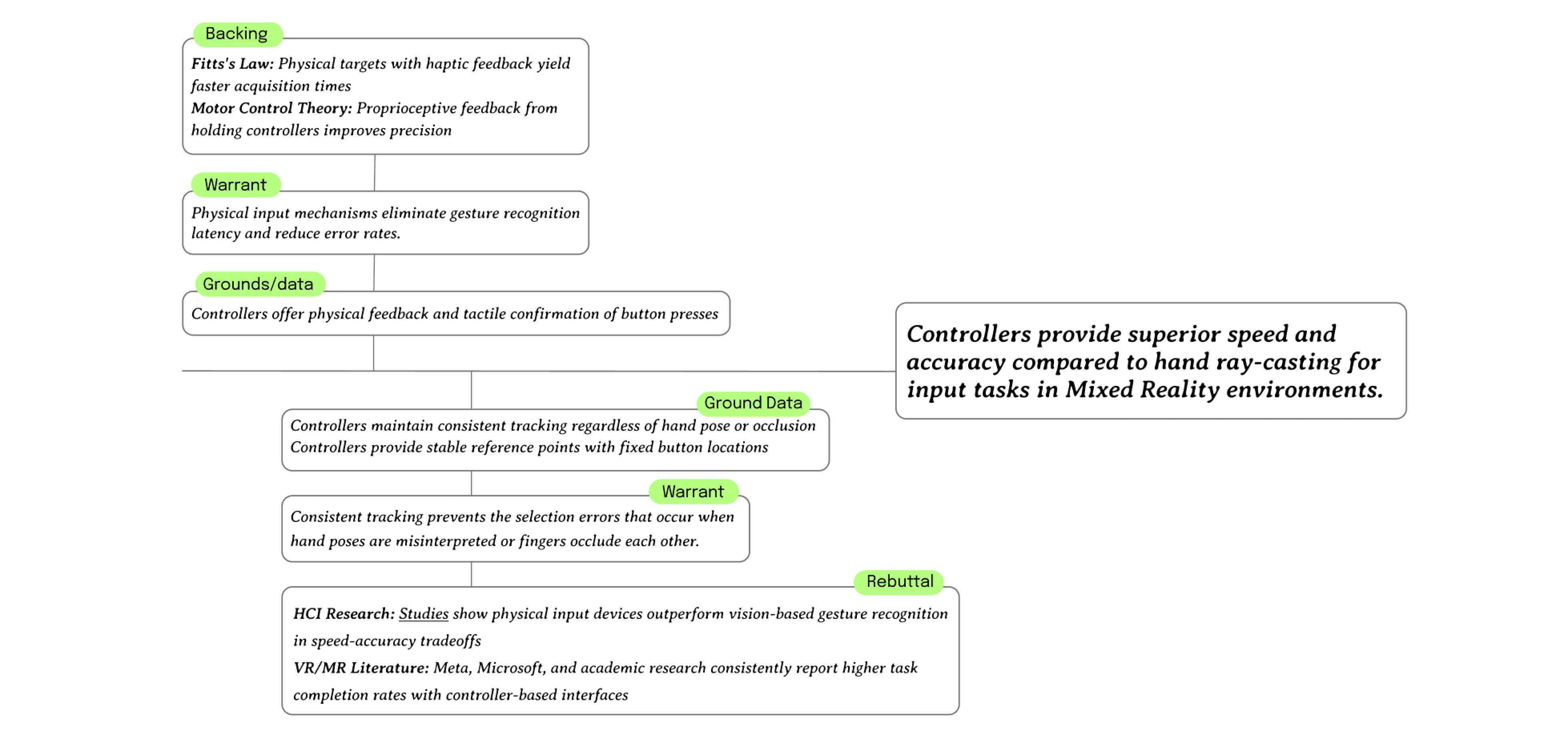
Theoretical Backing (Toulmin's Model)
Controllers provide superior performance because:
Haptic feedback eliminates gesture latency.
Consistent tracking reduces misinterpretation.
Motor control theory supports higher precision with proprioceptive feedback.
Research consistently shows controllers outperform gesture input in task completion rates.
Research Design
Study Type: Experimental (within-subjects)
Participants: 32
Independent Variable: Raycasting Method (Controller / Hand)
Dependent Variables: Speed (s), Accuracy (%), Preference, Ease of use.
Controls:
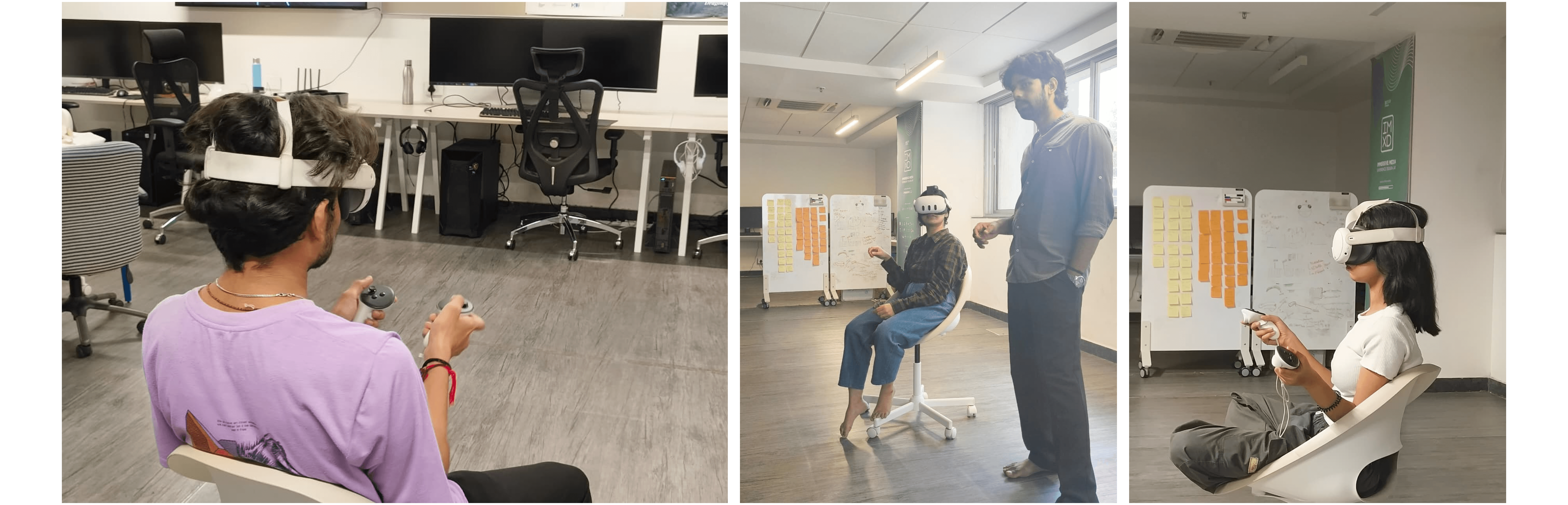
Same MR environment and headset (Meta Quest 3)
Equal practice time (10 attempts per method)
Counterbalanced task order

Try it out yourself: prototype link
Data Collection Instruments
Metric | Instrument | Measurement | Units |
|---|---|---|---|
Speed | Application | Average time taken to hit 30 targets. | Seconds |
Accuracy | Application | Average distance from the center of the target hit across 30 attempts. | Percentage |
Preference | Verbal | Which is the preferred method, Hand or Controller? | Binomial |
Ease of Use | Likert Scale | 1-5 (Easy, Relatively easy, Neutral, Relatively difficult, Difficult) | Ordinal scale |
Visualizations of observed data
Statistical Tests
Paired T-Test (speed, accuracy)
Independent KS Test (ease of use)
Spearman Correlation (speed vs. accuracy)
Paired T Test for Speed
95% CI for difference in speeds = -0.79 to -0.29
p<0.05
Controller Speed | Hand Speed | |
|---|---|---|
N | 31 | 31 |
SD of Sample (s) | 0.3 | 0.7 |
Observed Mean | 1.2 | 1.7 |
Paired t test | -2.477 | |
DOF | 30 | |
p value (2 tailed) | 0.00004277 |
The confidence interval confirms this, showing the Hand method takes between 0.29 and 0.79 seconds longer on average.
The Controller method is statistically significantly faster than the Hand method
Paired T Test for Accuracy
95% CI for difference in accuracy (Controller - Hand) = -0.94 to 0.58
p>0.05
Controller Speed | Hand Speed | |
|---|---|---|
N | 31 | 31 |
SD of Sample (s) | 2 | 1.5 |
Observed Mean | 2.9 | 3.1 |
Paired t test | -0.731 | |
DOF | 30 | |
p value (2 tailed) | 0.6284 |
We do not have sufficient evidence to conclude that the Controller method is statistically significantly different in accuracy from the Hand method.
Independent KS Test
D statistic | 0.452 |
|---|---|
D crit alpha = 0.01 | 0.414 |
D crit alpha = 0.05 | 0.345 |
n | 31 |
Categories | s |
Dstat > Dcrit
0.452 > 0.345
There is a statistically significant difference in the distribution of "Ease of Use" ratings between the Controller and the Hand device.
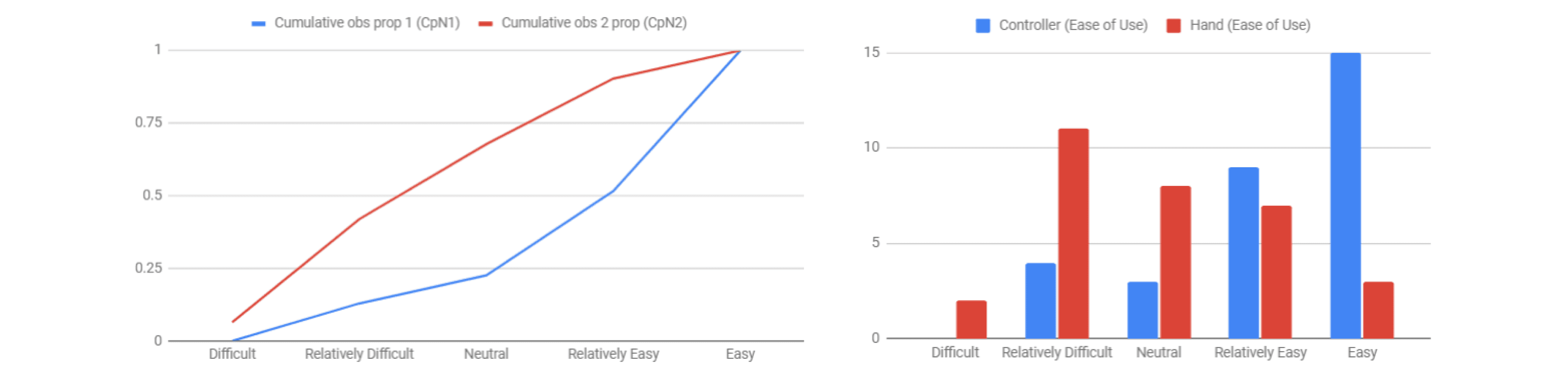
Controller raycasting was found to be easier to use than hand raycasting.
Future Work
Target Size and Distance
Mixed reality offers a third dimension where targets can be placed anywhere across the Z dimension as well we can repeat the experiment with varying the size and distance of targets in a Fitts' Law-style experiment to precisely model the trade-off between the two methods.
Fine Motor Skills
Precision tasks like drawing or manipulating small objects, using both the input methods.

We are a team of four; Tanushree Pillai, Srishti Rachna, Kanishk Kamal, and myself, who conducted this study as part of a course module at IDC, IIT Bombay. We sincerely thank Prof. Anirudha Joshi and Prof. Karthikeyan for their guidance throughout the course, and Prof. Jayesh Pillai for his support in setting up the VR experiments at the IMXD Lab, IDC.